
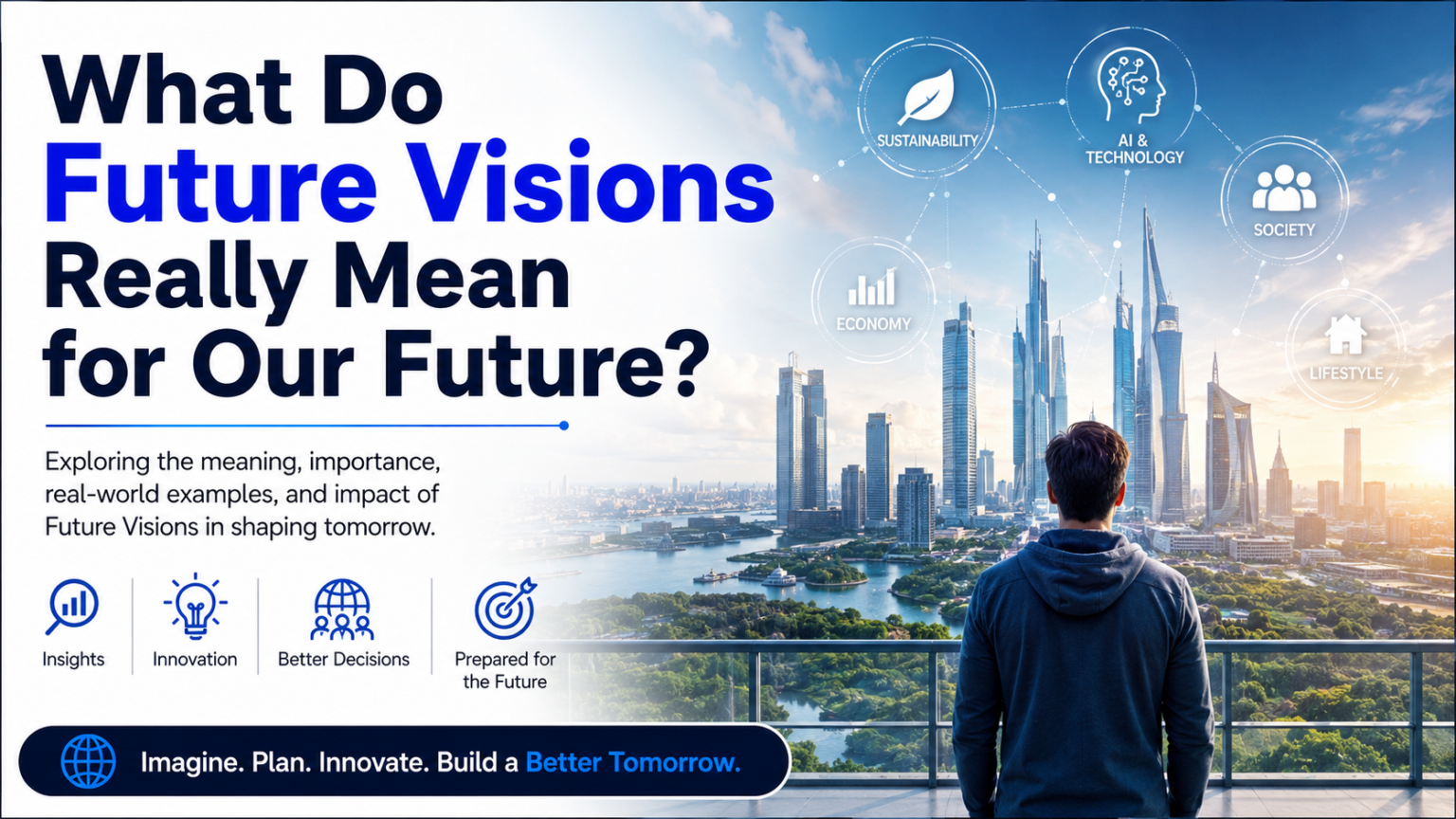

Future Visions refer to ideas, predictions, and frameworks that imagine what the future could look like based on current trends, technology, and human behavior. They are used in business, science, and society to guide planning and decision-making. Instead of predicting a single outcome, Future Visions explore multiple possible futures to help people prepare, adapt, and innovate more effectively.
Fast Info Table
| Category | Details |
|---|---|
| Term | Future Visions |
| Meaning | Ideas and predictions about possible future outcomes |
| Used In | Business, technology, innovation, planning |
| Purpose | Guide decisions and prepare for change |
| Focus Areas | AI, society, economy, environment, lifestyle |
| Nature | Exploratory, not exact prediction |
Understanding the Core Idea of Future Visions
Future Visions are not fixed predictions. They are structured ways of imagining different possibilities based on current data and trends. Experts use them to think about how the world may evolve in the next 10, 20, or even 50 years.
These visions often combine:
- Data analysis
- Trend forecasting
- Human behavior studies
- Technological progress
The goal is not to be perfectly accurate but to expand thinking and reduce uncertainty.
Why Future Visions Matter in Today’s World
Future Visions are important because the world is changing faster than ever. Businesses, governments, and individuals use them to stay prepared.
Key reasons they matter:
- Help organizations plan long-term strategies
- Support innovation by exploring “what if” scenarios
- Reduce risks by preparing for uncertainty
- Improve decision-making in uncertain markets
In simple terms, Future Visions act like a mental roadmap for possible futures, helping people avoid being caught off guard.
How Future Visions Are Created and Used
Future Visions are built using structured methods rather than guesswork. Analysts and strategists combine research and creative thinking to form realistic scenarios.
Common methods include:
- Trend analysis (studying current patterns)
- Scenario planning (building multiple future outcomes)
- Expert insights from researchers and industry leaders
- Data modeling using technology and AI tools
They are widely used in:
- Technology development
- Urban planning
- Business strategy
- Environmental forecasting
This approach helps organizations make smarter, forward-thinking decisions.
Real-World Examples of Future Visions
Future Visions can already be seen in many areas of modern life.
Examples include:
- Smart cities using AI traffic systems and automation
- Electric vehicles replacing fuel-based transport
- Remote work becoming a long-term global model
- AI assistants supporting daily human tasks
- Sustainable energy replacing fossil fuels
Each example shows how present innovations are shaped by imagined future possibilities.
Challenges and Impact of Future Visions
While Future Visions are powerful, they are not always accurate. Unexpected events, like global crises or rapid technological breakthroughs, can change outcomes quickly.
Key challenges:
- Uncertainty in long-term predictions
- Overreliance on data trends
- Difficulty predicting human behavior
- Rapid technological disruption
Impact:
Despite limitations, Future Visions still play a major role in shaping innovation. They encourage people to think ahead, prepare better systems, and create flexible strategies for change.
Conclusion
Future Visions are structured ways of imagining possible futures using data, trends, and expert insight. They help individuals and organizations prepare for change, reduce uncertainty, and make better decisions. While they are not exact predictions, they are powerful tools for planning and innovation in a fast-changing world.
FAQs
1. What are Future Visions in simple words?
Future Visions are ideas about what the future might look like based on current trends and knowledge.
2. Are Future Visions accurate predictions?
No, they are not exact predictions. They show possible scenarios, not guaranteed outcomes.
3. Who uses Future Visions?
Businesses, governments, researchers, and tech companies use them for planning and strategy.
4. Why are Future Visions important?
They help people prepare for change, reduce risks, and improve long-term decision-making.