
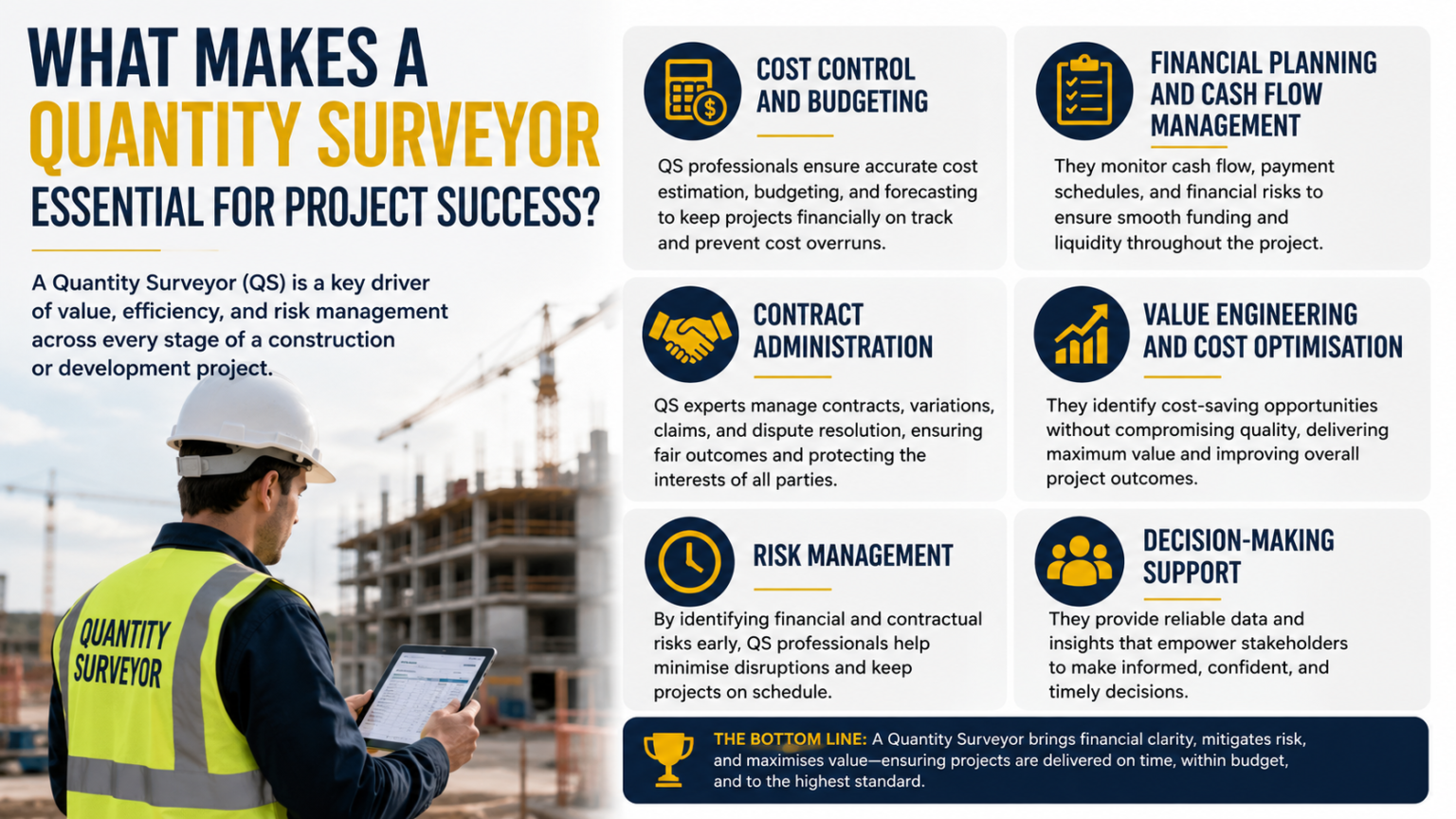

A Quantity Surveyor is essential for project success because they manage construction costs, budgets, and contracts from start to finish. They ensure that projects do not exceed financial limits while still maintaining quality and efficiency. Without a Quantity Surveyor, construction projects often face budget overruns, poor cost planning, and financial risks that can delay or even stop completion. In simple terms, they act as the financial controller of any construction project.
Fast Info Table: Quantity Surveyor Overview
| Category | Details |
|---|---|
| Role | Cost management and contract control in construction |
| Industry | Construction, infrastructure, real estate |
| Education | Degree in Quantity Surveying, Civil Engineering, or Construction Management |
| Key Skills | Budgeting, cost estimation, negotiation, analytics |
| Work Type | Office + site-based |
| Main Goal | Deliver projects within budget and financial efficiency |
| Career Level | Junior QS → Senior QS → Commercial Manager |
What is a Quantity Surveyor?
A Quantity Surveyor is a construction professional who focuses on managing all financial aspects of building projects. Their main responsibility is to estimate costs, prepare budgets, and ensure money is used efficiently throughout the project lifecycle.
They work closely with engineers, architects, and contractors to make sure every part of construction is financially planned. From the first design stage to project completion, the Quantity Surveyor ensures that spending stays controlled and transparent.
Key Responsibilities in Project Success
A Quantity Surveyor plays a major role in keeping construction projects stable and well-managed. Their responsibilities directly impact project success.
Key duties include:
- Preparing cost estimates before construction begins
- Creating Bills of Quantities (BOQ) for materials and labor
- Managing contracts and tender documents
- Monitoring ongoing project expenses
- Handling payment certificates for contractors
- Managing variations and unexpected cost changes
- Ensuring legal and financial compliance
These tasks help prevent overspending and reduce financial risks, making projects more predictable and controlled.
Skills Required to Become a Successful Quantity Surveyor
To perform effectively, a Quantity Surveyor needs both technical and soft skills.
Important skills include:
- Strong mathematical and analytical ability
- Knowledge of construction methods and materials
- Cost estimation and budgeting skills
- Negotiation and communication skills
- Attention to detail
- Problem-solving ability
A successful Quantity Surveyor must also understand contracts and legal terms used in construction. This helps them avoid disputes and ensure smooth project execution.
How Quantity Surveyor Improves Cost Control and Efficiency
Cost control is the most important part of a Quantity Surveyor’s job. They ensure that every expense is planned, tracked, and justified.
They improve efficiency by:
- Identifying unnecessary costs early
- Suggesting cheaper but effective material alternatives
- Monitoring real-time spending during construction
- Preventing budget overruns through constant analysis
- Supporting decision-making with accurate financial data
By doing this, they help project owners save money while still achieving high-quality construction results. This balance between cost and quality is what makes them extremely valuable.
Career Path and Importance in Construction Industry
The career of a Quantity Surveyor offers strong growth opportunities. Most professionals start as trainees and gradually move into senior positions.
Typical career path:
- Assistant Quantity Surveyor
- Junior Quantity Surveyor
- Senior Quantity Surveyor
- Commercial Manager
- Project or Contracts Manager
Their importance in the construction industry continues to grow because modern projects are becoming larger and more expensive. Without proper cost management, these projects cannot succeed financially.
A Quantity Surveyor ensures that every project remains viable, profitable, and well-managed from start to finish.
Conclusion
A Quantity Surveyor is essential for ensuring construction projects are completed within budget, on time, and with financial control. They manage costs, handle contracts, and reduce financial risks throughout the project lifecycle. Their role directly supports project success by balancing quality and affordability.
FAQs
1. What does a Quantity Surveyor do in simple terms?
They manage construction costs and ensure projects stay within budget.
2. Is Quantity Surveying a good career?
Yes, it offers strong job demand, good salaries, and career growth.
3. Do Quantity Surveyors work on-site or in offices?
They work in both environments depending on project needs.
4. What is the main goal of a Quantity Surveyor?
To control costs and ensure financial efficiency in construction projects.