
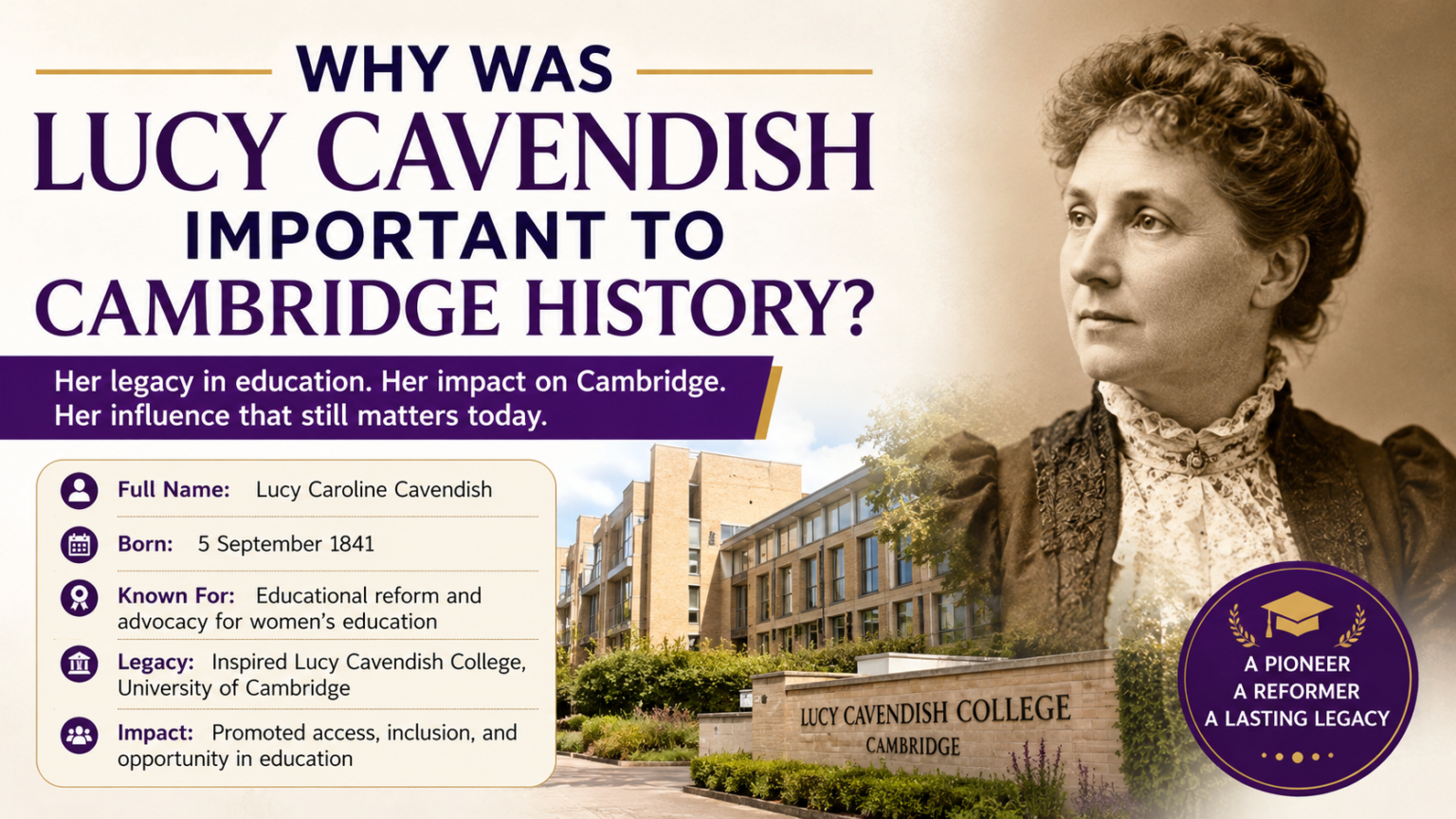

Lucy Cavendish was important to Cambridge history because she helped advance women’s education in Britain during a time when universities offered limited opportunities to female students. Her work in educational reform inspired the creation of Lucy Cavendish College, a college within University of Cambridge that was founded to support women and later became known for widening access to higher education.
| Quick Facts | Details |
|---|---|
| Full Name | Lucy Caroline Cavendish |
| Born | 5 September 1841 |
| Died | 22 April 1925 |
| Nationality | British |
| Known For | Educational reform and women’s education |
| Husband | Lord Frederick Cavendish |
| Major Legacy | Inspired Lucy Cavendish College |
| Associated With | University of Cambridge |
| Main Focus | Expanding educational opportunities for women |
Early Life and Educational Influence
Lucy Cavendish was born into an influential British family and developed a strong interest in education early in life. During the 19th century, women faced major barriers in higher education, especially at prestigious institutions like Cambridge.
After the death of her husband, Lord Frederick Cavendish, she became deeply involved in educational work. She supported schools, educational councils, and reform projects that aimed to improve learning opportunities for girls across Britain.
Her efforts helped change public attitudes toward women’s education at a time when many universities still excluded female students from full participation.
Her Role in Women’s Educational Reform
One reason Lucy Cavendish remains historically important is her long-term commitment to educational reform. She worked with several organizations focused on improving standards for girls’ schools and encouraging women to pursue advanced education.
She served in leadership positions connected to national education initiatives and became respected for her practical approach to reform. Her work helped create momentum for women seeking university-level education in Britain.
At the time, very few women had access to academic opportunities equal to men. Reformers like Lucy Cavendish played a key role in changing that system.
The Creation of Lucy Cavendish College
In 1965, Lucy Cavendish College was founded in her honor. The college became part of the University of Cambridge and originally focused on supporting women and mature students.
The college represented many of the values Lucy Cavendish supported during her lifetime:
- Better educational access
- Academic opportunity for women
- Inclusive learning environments
- Support for non-traditional students
Over time, the college gained a reputation for welcoming students from diverse educational and social backgrounds.
In 2021, the college officially became coeducational, admitting students of all genders while continuing its mission of widening participation in higher education.
Why Her Legacy Still Matters Today
Lucy Cavendish’s influence can still be seen in modern conversations about equal access to education. Many universities now focus on diversity, inclusion, and support for underrepresented students — ideas connected to the educational reforms she supported more than a century ago.
Her legacy is especially visible at Cambridge, where Lucy Cavendish College continues to encourage applications from students who may not have traditionally considered elite universities accessible.
Today, she is remembered not only as an education reformer but also as a symbol of progress in British academic history.
Lasting Impact on Cambridge History
Lucy Cavendish became an important figure in Cambridge history because her values helped shape one of the university’s modern colleges and influenced broader discussions about fairness in education.
Although she was not a Cambridge academic herself, her work contributed to long-term educational change in Britain. Naming a Cambridge college after her reflected the lasting respect for her efforts in advancing opportunities for women.
Her story also highlights how educational reformers outside universities can still shape academic institutions for future generations.
Conclusion
Lucy Cavendish played a major role in supporting women’s education during a transformative period in British history. Her dedication to educational reform inspired the founding of Lucy Cavendish College at Cambridge and helped promote wider access to higher education. Today, her legacy remains closely connected to inclusion, opportunity, and academic progress.
FAQs
Who was Lucy Cavendish?
Lucy Cavendish was a British education reformer known for supporting women’s access to education in the 19th century.
Why was Lucy Cavendish College created?
The college was founded to expand educational opportunities for women and mature students at Cambridge.
Is Lucy Cavendish College part of Cambridge University?
Yes, it is one of the colleges within the University of Cambridge.
What is Lucy Cavendish remembered for today?
She is remembered for her contributions to women’s education and her lasting influence on educational reform in Britain.