
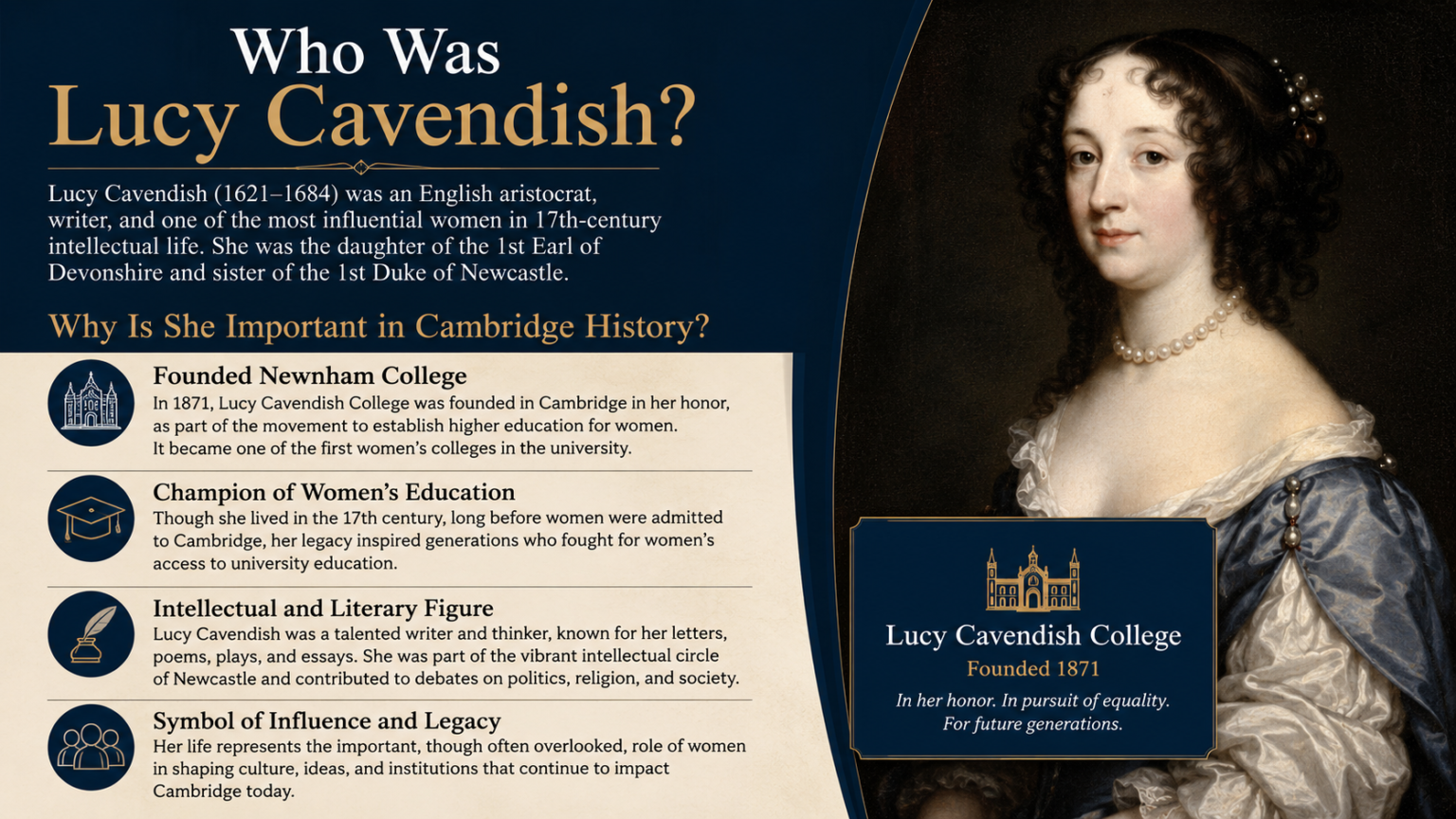

Lucy Cavendish was a British education reformer who played an important role in improving opportunities for women in higher education during the late 19th and early 20th centuries. She is best known for supporting women’s access to universities and public education in Britain. Her legacy became even more significant when Lucy Cavendish College at the University of Cambridge was named in her honor, recognizing her contributions to women’s education and academic equality.
| Fast Facts About Lucy Cavendish | Details |
|---|---|
| Full Name | Lucy Caroline Cavendish |
| Birth Year | 1841 |
| Death Year | 1925 |
| Nationality | British |
| Known For | Women’s education reform |
| Husband | Lord Frederick Cavendish |
| Major Legacy | Lucy Cavendish College, Cambridge |
| Main Field | Education and social reform |
| Famous Role | Advocate for women’s higher education |
Early Life and Family Background
Lucy Cavendish was born into the influential Lyttelton family in England in 1841. Her upbringing exposed her to politics, education, and public service from an early age. In 1864, she married Lord Frederick Cavendish, a respected British politician.
Her life changed dramatically in 1882 when her husband was killed during the Phoenix Park Murders in Dublin. After this tragedy, Lucy Cavendish dedicated much of her life to educational reform and public service. Rather than stepping away from society, she became deeply involved in improving opportunities for girls and women across Britain.
Her determination and public work later made her one of the most respected female education advocates of her era.
Her Contributions to Women’s Education
Lucy Cavendish became widely known for promoting better education for women at a time when university access was still limited. She strongly believed that women deserved the same educational opportunities as men.
Some of her most important contributions included:
- Supporting girls’ secondary education
- Encouraging women to enter universities
- Working with educational organizations across Britain
- Promoting academic standards for women’s schools
She also served as President of the Yorkshire Ladies Council of Education for many years. Through this role, she influenced discussions about school reforms and women’s academic development.
Lucy Cavendish helped shape public attitudes toward women in higher education during a period when female students often faced social and institutional barriers.
The Connection Between Lucy Cavendish and Cambridge
The connection between Lucy Cavendish and Cambridge became permanent in 1965 when Lucy Cavendish College was founded at the University of Cambridge.
The college was originally created to support women and mature students who had fewer opportunities in traditional university systems. Naming the institution after Lucy Cavendish reflected her lifelong dedication to educational equality and intellectual advancement.
Over time, the college became known for:
- Academic excellence
- Diversity and inclusion
- Support for non-traditional students
- Expanding access to Cambridge education
Today, the college welcomes students from many backgrounds and continues to represent the values Lucy Cavendish supported throughout her life.
Why Her Legacy Still Matters Today
Lucy Cavendish remains important because her work contributed to long-term changes in British education. Many opportunities available to female students today were influenced by reformers like her who challenged outdated systems.
Her legacy matters for several reasons:
| Lasting Impact | Why It Matters |
|---|---|
| Women’s university access | Helped normalize higher education for women |
| Educational reform | Improved public discussion around girls’ education |
| Cambridge recognition | Inspired one of Cambridge’s modern colleges |
| Social progress | Encouraged wider academic inclusion |
Modern universities continue to focus on diversity, equal opportunity, and educational accessibility. These goals connect closely with the principles Lucy Cavendish supported more than a century ago.
Recognition and Historical Importance
Lucy Cavendish received respect from educational institutions and reform groups throughout her lifetime. In 1904, the University of Leeds awarded her an honorary Doctor of Laws degree for her contributions to education.
Historians often describe her as part of a broader movement that transformed women’s educational opportunities in Britain. Although she was not the founder of a university herself, her advocacy and leadership helped create an environment where women could pursue advanced academic careers.
Her name remains strongly associated with Cambridge history because Lucy Cavendish College continues to honor her mission of expanding access to education.
Conclusion
Lucy Cavendish was an influential British education reformer whose work helped improve opportunities for women in higher education. Her dedication to academic equality, public service, and educational reform left a lasting impact on British society. Today, her name continues to hold importance through Lucy Cavendish College at Cambridge, which reflects the values she spent her life promoting.
FAQs
Who was Lucy Cavendish?
Lucy Cavendish was a British advocate for women’s education and social reform during the late 19th century.
Why is Lucy Cavendish important in Cambridge history?
She is important because Lucy Cavendish College at the University of Cambridge was named after her to honor her contributions to women’s education.
What was Lucy Cavendish known for?
She was mainly known for supporting women’s access to higher education and promoting educational reform in Britain.
When was Lucy Cavendish College founded?
Lucy Cavendish College was founded in 1965 at the University of Cambridge.